 Get Halloween 15% for Limited Time on Lifetime & Bundle Deal


A taxi booking WordPress plugin turns an ordinary WordPress site into a dispatch and reservation platform, but the licence fee is rarely the whole bill. This guide breaks down every cost line a taxi operator faces in 2026 – plugin licences, WooCommerce payment processing, hosting, SMS and map add-ons, plus the labour you will spend setting fares and driver rules – so you can build a realistic budget before you buy anything.
- What You Are Actually Paying For
- Licence Models: What Drives the Price
- Hidden and Recurring Costs to Budget For
- Build Your Own Cost Estimate: A Simple Method
- Free Plugin, Paid Plugin or Custom Build?
- Where the Money Goes on the Booking Page
- How to Keep Lifetime Costs Down
- Common Budgeting Mistakes
- Frequently Asked Questions
- The Bottom Line
What You Are Actually Paying For
A taxi booking plugin is software that lives inside WordPress and handles vehicle types, fare calculation, driver assignment, booking schedules and customer notifications. The plugin itself is one line item. Around it sit services that the plugin depends on to work in the real world.
Think of your total cost of ownership in four buckets:
- Software licences – the plugin, plus any premium add-ons you need for features like recurring rides, peak-hour pricing or driver apps.
- Transaction fees – what your payment gateway charges on every booking, which scales with revenue rather than with your licence count.
- Infrastructure – hosting, domain, SSL, and the mapping or SMS services the booking flow calls on.
- Setup and maintenance – your time, or a developer’s, plus yearly renewals and ongoing checks.
Online quotes and vendor pages change often, so treat every figure below as a line to verify rather than a fixed promise. Check current pricing on the vendor’s own site before you commit.
Licence Models: What Drives the Price
Most taxi booking plugins in the WordPress ecosystem price by licence tier rather than by a flat one-off charge. The variables that move the number are consistent across vendors.
Site count and environment
A single-site licence covers one live WordPress install. Multi-site or agency licences cover several. If you run separate sites for different cities or brands, this is the tier that decides your bill.
Annual versus lifetime
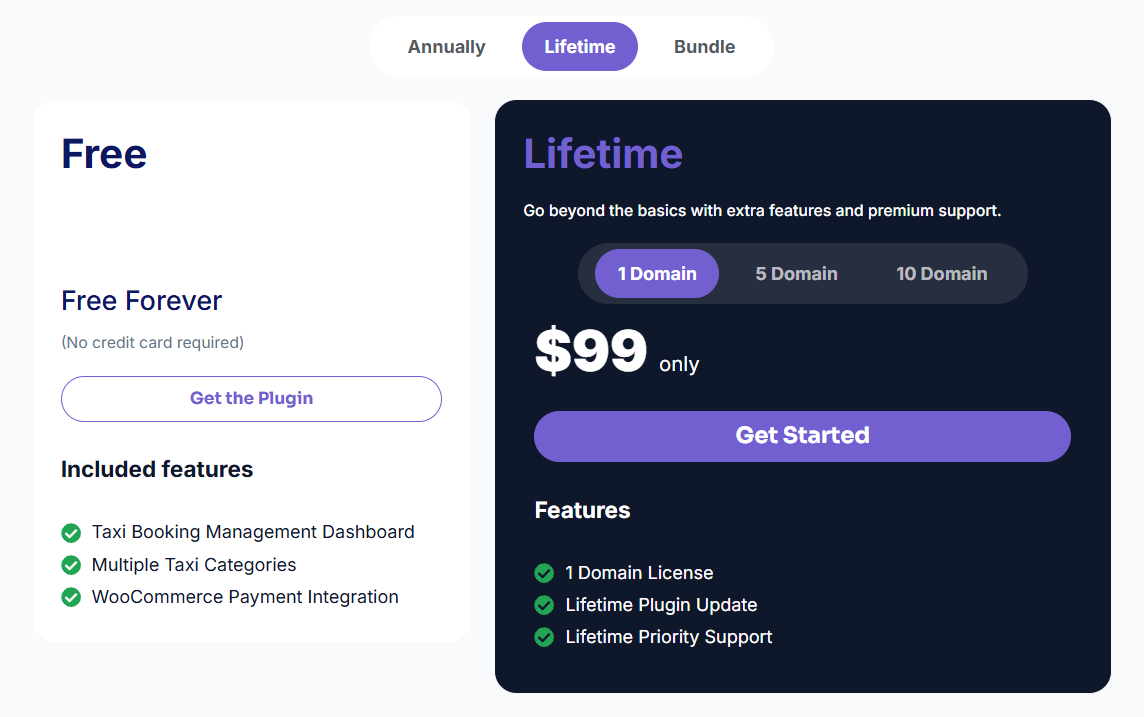
Annual licences usually include updates and support for twelve months and must be renewed to keep receiving them. Lifetime licences cost more up front and typically still bundle a support window. For a taxi business that changes fares and vehicle types regularly, ongoing updates matter more than they do for a static brochure site.
Add-on bundling

Some plugins ship everything in one package; others sell driver management, mobile apps, or advanced reporting as separate add-ons. Before comparing two headline prices, list which add-ons you actually need, then compare the totals. A cheaper base licence with three required add-ons can cost more than a single bundled licence.
What is not included at any tier
- Payment gateway setup and any gateway-side application fees.
- SMS credits, which are almost always billed by a third-party provider per message.
- Mapping API quotas beyond a provider’s free monthly allowance.
- Custom development for fare rules unique to your business.
Hidden and Recurring Costs to Budget For
These are the lines that surprise operators in year two. None of them are unique to taxis, but a booking site uses all of them more heavily than a brochure site.
Payment processing
If you take bookings through WooCommerce, every gateway charges a percentage plus a fixed amount per transaction. Card-on-file, wallets, and local mobile payment methods often carry different rates. Model your gateway fees against your expected monthly booking volume, not against your best-case month.
SMS and email notifications
Booking confirmations, driver-assigned alerts and ride reminders are what stop no-shows, but SMS is metered. Estimate the messages per booking – confirmation, driver assigned, arriving now, completed – and multiply by your monthly ride count.
Maps, geocoding and distance calculation
Address autocomplete and distance-based fares rely on a mapping provider. Most providers include a free monthly quota and then charge per request. A high-traffic booking page can pass that quota faster than you expect.
Hosting and performance
Booking pages run database queries on every search, so shared budget hosting often buckles. Budget for hosting that can handle concurrent users, plus SSL and daily backups. This is an unavoidable recurring cost, not an optional upgrade.
Driver payouts and reconciliation
If drivers are paid per completed trip, you need either manual reconciliation time or a tool that automates it. Both have a cost – one in hours, one in licence fees.
Build Your Own Cost Estimate: A Simple Method
Instead of quoting invented totals, work through this sequence with real numbers from your own business.
- List required features against your booking flow: vehicle types, distance or zone fares, one-way and round trips, driver assignment, cancellation rules, and payment method.
- Match each feature to a licence tier or add-on, using each vendor’s current published feature list.
- Add a payment gateway estimate based on your gateway’s published rate times your monthly booking value.
- Add notification costs using your expected messages per booking.
- Add hosting and mapping at the level your traffic needs.
- Multiply annual fees by three years so the first-year price does not flatter an expensive long-term option.
A three-year view is the single most useful thing you can do before choosing a plugin. It exposes licence models that look cheap in year one and costly in year three.
Free Plugin, Paid Plugin or Custom Build?
| Approach | Typical cost profile | Best fit |
|---|---|---|
| Free plugin | No licence fee; you pay for hosting, setup time, and limited features | Testing an idea or a very small fleet |
| Premium plugin + add-ons | Annual or lifetime licence plus per-feature add-ons | Operators who want dispatch and payments without hiring developers |
| Custom development | One-off build plus ongoing maintenance and hosting | Unusual fare logic or deep integration with existing dispatch software |
Be sceptical of the free route if you need driver management or distance-based fares – those are the features free versions most often withhold. If a no-cost option is your priority, it is worth reading a comparison of free WordPress booking plugins for small businesses before you assume you must pay for everything.
Where the Money Goes on the Booking Page
Cost decisions usually trace back to three screens a customer actually touches.
Search and fare estimate
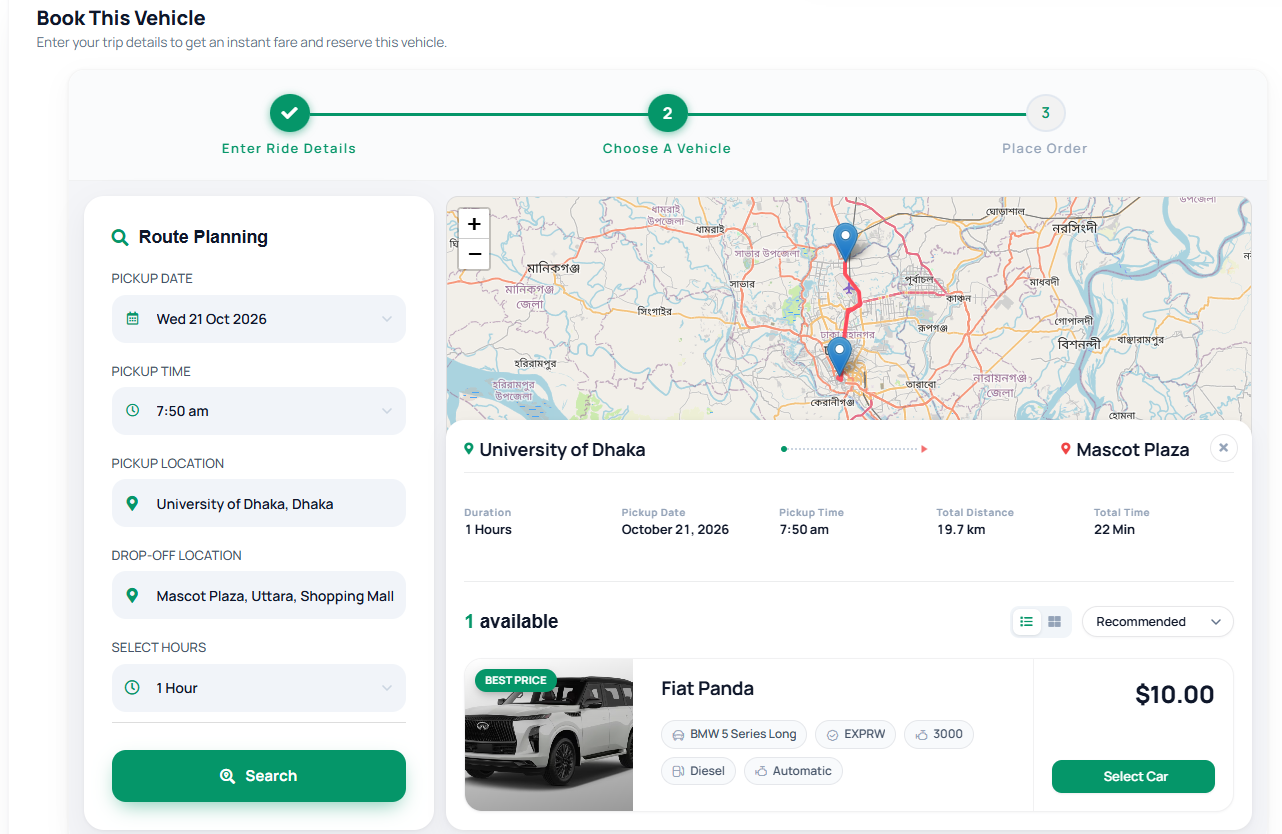
Pickup, drop-off, date, and vehicle type. Distance-based pricing here calls the mapping API, so this is where mapping quotas get consumed.
Extras and pricing rules

Child seats, luggage, waiting time, and airport surcharges. Each extra is a pricing rule you must configure, and each configuration is setup time. Operators who charge more at busy times should plan for adding peak-hour pricing to a taxi booking website, which is a configuration project rather than a licence purchase.
Checkout and confirmation
Payment, then the notification sequence. This is the step that generates SMS costs and gateway fees on every single trip, so it deserves its own line in your spreadsheet.
How to Keep Lifetime Costs Down
- Buy only the add-ons you will launch with. Add features after the first hundred bookings teach you what customers actually use.
- Batch notifications. One well-timed reminder prevents more no-shows than four automated messages.
- Cache aggressively and optimise queries so hosting stays modest and mapping calls are not repeated for the same address.
- Set a renewal calendar. Licence lapses break support and security updates without any warning on the front end.
- Review gateway rates yearly. Rates and available payment methods shift, and a five-minute switch can move your per-booking margin.
Common Budgeting Mistakes
Comparing headline licence prices only
Two plugins at the same licence price can differ enormously once you add the add-ons your operation needs.
Ignoring transaction fees entirely
Licence fees are fixed; gateway and SMS costs scale with success. A growing taxi business can pay more in fees in year two than it did for the licence in year one.
Under-budgeting setup labour
Fare zones, vehicle classes and cancellation policies all need configuration and testing. Assign real hours to it, whether yours or a contractor’s.
Forgetting the second year
Renewals, hosting and support all recur. Build the three-year total before you sign anything.
Frequently Asked Questions
Is a taxi booking WordPress plugin a one-time purchase?
Usually not. Many vendors sell annual licences with renewals, and even lifetime licences typically include a limited support term. Confirm what is bundled and what recurs before comparing options.
Do I need WooCommerce to take bookings?
Not always, but WooCommerce gives you a mature checkout, tax handling and multiple gateways. It also introduces per-transaction fees you would not pay with pay-on-arrival only.
What is the smallest realistic budget?
It depends on whether you accept online payments and send SMS. Pay-on-arrival with email notifications removes two recurring cost lines; a card-based booking flow adds them back immediately.
Can I start free and upgrade later?
Often yes, but data migration between plugins is rarely automatic. Choose a plugin whose free tier and paid tier share a data structure if you plan to upgrade.
The Bottom Line
Budgeting for a taxi booking WordPress plugin is less about the sticker price and more about the recurring lines around it. Compare licences on a three-year basis, model gateway and SMS fees against real booking volume, and treat hosting and mapping as fixed obligations rather than optional extras. If you have already decided on a plugin and just need to build the site, start with a step-by-step guide to making a taxi booking website in WordPress and if you want to see how two vendors stack up side by side, our comparison of the best taxi booking plugins for WordPress covers that judgement call instead.