

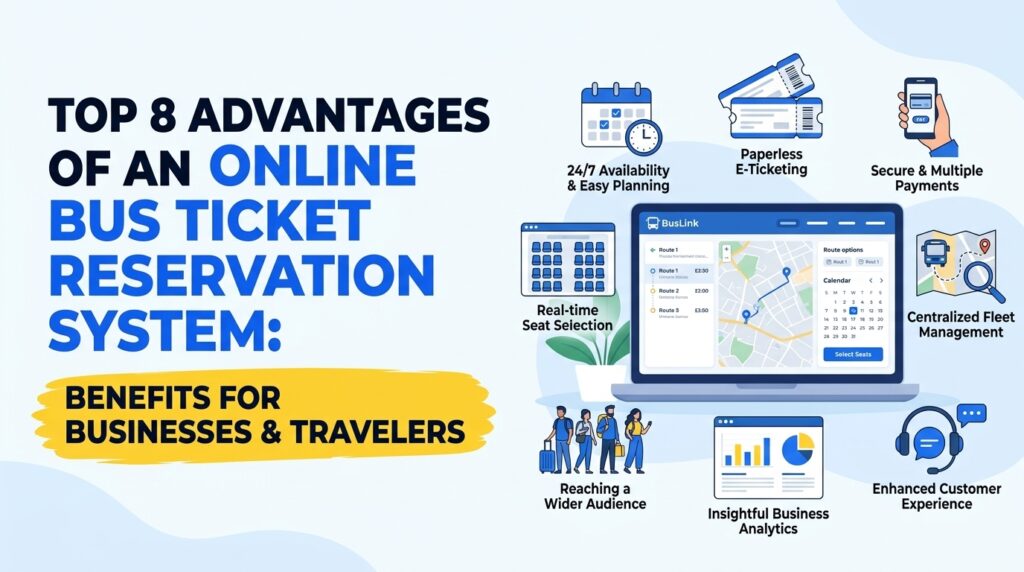
The biggest advantages of an online bus ticket reservation system are round-the-clock booking, fewer manual errors, real-time seat availability, faster payments and richer passenger data. For operators, it replaces paper manifests and phone bookings with a single digital platform. For travellers, it turns a trip to the counter into a 60-second transaction on a phone. Below is a practical look at what those benefits mean day to day, for both bus companies and the people who ride with them.
What an Online Bus Ticket Reservation System Does
An online bus reservation platform connects route schedules, seat inventory, pricing and payments in one place. Passengers search a route and date, pick a seat from a live seat map, pay by card or wallet, and receive an e-ticket with a QR code. Behind the scenes, the operator sees updated occupancy, revenue and passenger manifests instantly across every channel — website, mobile app, agent portal and ticket counter.
Key Advantages for Passengers
1. Booking Any Time, From Anywhere
Counters close; websites do not. A digital booking system lets travellers reserve seats at midnight, from another city or from abroad. This matters most during festival seasons and holiday peaks, when queues are longest and seats sell out fastest.
2. Transparent Seat Selection and Pricing
Live seat maps show exactly which seats remain — window, aisle, lower berth or upper berth — along with the fare, boarding points and drop-off points. There is no ambiguity about what a passenger is paying for, which reduces disputes at boarding.
3. Secure, Cashless Payment
Integrated payment gateways support cards, mobile wallets, bank transfers and, in many markets, buy-now-pay-later options. Passengers avoid carrying cash, and operators reduce the risks and reconciliation work that come with handling notes and coins at dozens of counters.
4. Instant Confirmation and Easy Changes
E-tickets arrive by email or SMS within seconds. Self-service cancellation and rescheduling, governed by rules the operator defines, cut down on support calls. Automated departure reminders and delay notifications keep passengers informed without a staff member making phone calls.
Key Advantages for Bus Operators
5. Lower Operating Costs
Online booking reduces dependence on physical counters, printed tickets and large call-centre teams. Staff time shifts from repetitive data entry to customer service and operations. Many operators also cut agent commissions by driving a larger share of sales through their own direct channels.
6. Fewer Errors, Overbookings and No-Shows
Manual ledgers invite double-booked seats and misread handwriting. A centralised inventory locks a seat the moment it is paid for, across every sales channel simultaneously. Prepayment also lowers no-show rates compared with hold-and-pay-later arrangements, protecting revenue on each departure.
7. Better Revenue Management
With live occupancy data, operators can apply dynamic or tiered pricing: early-bird discounts to fill seats weeks ahead, higher fares as departure nears and demand rises. Promo codes, loyalty points and return-trip bundles become simple to run and measure. Ancillary revenue — extra baggage, priority boarding, seat upgrades, insurance — can be offered at checkout, where conversion is highest.
8. Data and Reporting That Drive Decisions
Every booking generates useful information:
- Route performance: which departures consistently run full and which run half-empty
- Demand patterns: peak days, lead times and seasonal swings
- Channel mix: how much revenue comes from the website, app, agents or counters
- Passenger behaviour: repeat travellers, preferred boarding points, cancellation reasons
Those insights guide fleet deployment, timetable changes and marketing spend far more reliably than intuition or end-of-month paper summaries.
Operational and Compliance Benefits
Digital manifests give drivers and terminal staff an accurate passenger list on a tablet or phone, with QR-code scanning at boarding. That speeds up departures and produces an auditable record of who travelled on which service — valuable for safety investigations, insurance claims and regulatory reporting.
Centralised records also simplify tax and accounting. Fare revenue, refunds and agent commissions are reconciled automatically rather than compiled by hand from dozens of counters. For companies operating across states or borders, this consistency is a significant administrative relief.
Wider Reach and Brand Growth
An online reservation platform extends a bus company’s market beyond the neighbourhoods around its terminals. Listings on aggregator marketplaces, search-engine visibility and app store presence bring in travellers who would never have found a physical counter. Collected email addresses and phone numbers — with consent — support re-marketing campaigns, loyalty programmes and off-peak promotions that build repeat business.
Sustainability and Passenger Confidence
Paperless ticketing removes thousands of printed stubs per month and the courier runs that once distributed them to agents. Reduced queuing also spreads passenger flow through terminals, easing congestion at peak departure times. For many riders, the ability to book and board without touching shared surfaces or handling cash is now an expectation rather than a perk.
What to Look For in a Booking System
Not every platform delivers these gains equally. When evaluating options, prioritise:
- Real-time inventory sync across web, app, agents and counters
- Mobile-first design, since most bookings now happen on phones
- Multiple payment methods relevant to your market, including local wallets
- Configurable cancellation and refund rules that match your commercial policy
- Open APIs for connecting aggregators, accounting software and GPS tracking
- Reliable uptime and support, because a booking outage is lost revenue
Conclusion
The advantages of an online bus ticket reservation system compound over time. Passengers get convenience, transparency and confidence; operators get lower costs, tighter inventory control, stronger revenue management and data they can act on. As travellers increasingly expect to plan and pay for journeys on a phone, digital reservation is no longer a competitive edge for bus companies — it is the baseline for staying in the market.
